What is it?
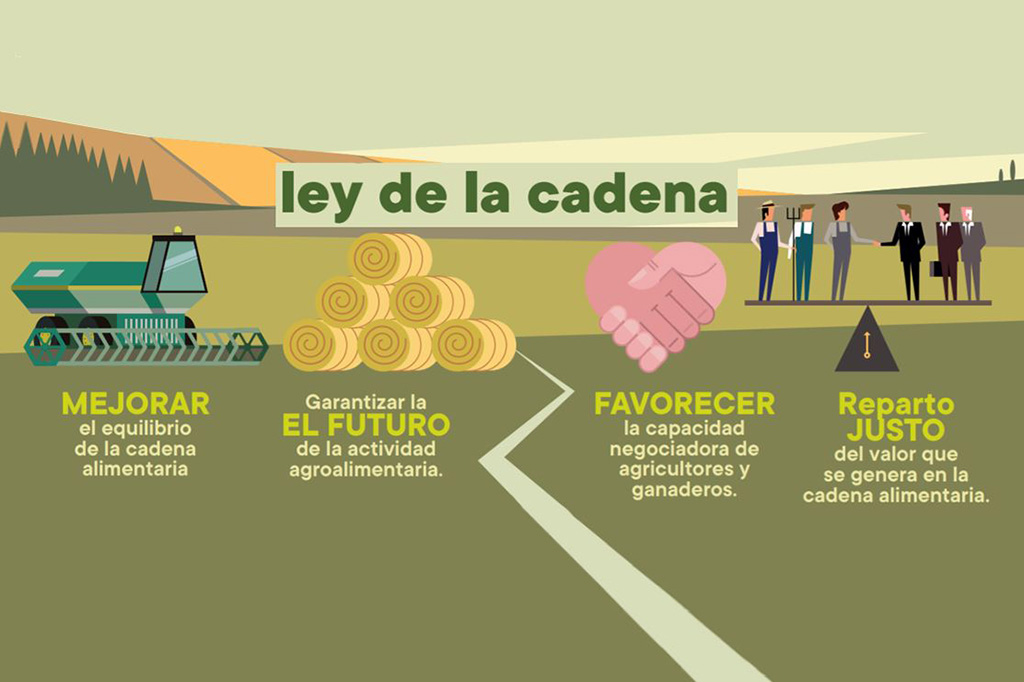
The Food Chain Law is the legal framework for protection against unfair trade practices in the food supply chain among the European Union. These unfair practices involve larger trading partners imposing conditions “contrary to good faith and fair dealing” in their trade agreements.
The application in Spain is carried out by Real Decreto Ley 5/2020. This reform includes new regulations regarding the effective cost of production and forbiddance on sales at a loss.
The entry into force of the law was on December 16, 2021. Contracts prior to this date had to adapt to the new obligations before May 1, 2022.
When it is used?
In all commercial relationships within the food chain, in which at least one state member of the European Union participates.
New obligations
Contracts must be formalized in writing, except those of less than €1,000 and cash payment transactions.
Determination of the effective cost, using the marketed production in an economic cycle as a reference. The supplier must be paid a price equal to or higher than the effective cost of producing such product. For final sale to the public, it will not be possible to offer a price lower than the product’s purchase price.
Promotions must be regulated and agreed between supplier and buyer, in order to disclose the product’s real price and the origin of the promotion. The aim of this measure is to avoid misleading consumers in relation to product prices and quality.
Infraction Management
Where infringements are committed, the sanctioning procedure will be governed by the law on the common administrative procedure of public administrations. In Spain, the enforcement authorities are the Agency for Food Information and Control (AICA) and the Ministry of Agriculture, Fisheries and Food.
Sanctions in 2022 first semester
AICA’s report for the first half of 2022 states that 354 ex officio inspections and 97 commercial relationships were carried out to ensure compliance with the Food Supply Chain Law. In total, 9 complaints were received and 95 penalties were imposed. 45% of the penalties relate to non-compliance with payment deadlines.
It should be noted that the fruit and vegetable sector is the one in which the most inspections have been carried out. In addition, AICA carried out 822 checks to confirm the existence of contracts and review their content in the fruit and vegetable sector.
The General Secretary of Agriculture and Food, Fernando Miranda, highlighted the importance of these actions to ensure compliance with the Law, as the best measure to deal with the situation suffered by agricultural markets as a result of climatic conditions and the invasion of Ukraine.
In a context in which the availability of raw materials plays such an important role in supplying the population, Fernando Miranda highlights the need for unity and commitment from the member countries, to advance the effectiveness of this law.
For the implementation of the law, it is essential that it be made known to all participants in the chain, so that all stakeholders take part in applying these rules. At Blasco Fruit, we want to support the implementation of this law by making it known to our partners through this post and by applying the regulations in our commercial relationships.